Categories
AGRICULTURE ECONOMY NEWS

LIMPAC & ACBF COMPLETE EMPOWERMENT PROGRAMS FOR LIBERIAN WOMEN ENTREPRENEURS & WOMEN AGRICULTURE COOPERATIVES

LIMPAC & ACBF COMPLETE EMPOWERMENT PROGRAMS FOR LIBERIAN WOMEN ENTREPRENEURS & WOMEN AGRICULTURE COOPERATIVES

With support from the African Capacity Building Foundation (ACBF) and the Arab Bank for Economic Development in Africa (BADEA), the Liberia Macroeconomic Policy Analysis Center with the Ministry of Finance and Development Planning has successfully completed three days events for the empowerment of Liberian Women in agriculture and women entrepreneurs. The three days event included a one-day Policy Advocacy Forum and two days leadership training for women agriculture cooperatives and women entrepreneurs. According to ACBF, the objective of the events is to promote sustainable agriculture in Africa with women at the forefront through the project: Empowerment of Women in Agriculture (EWA). The events are piloted in three African countries; Liberia, Rwanda, and Malawi.


Both the forum and the training spanned three days and were held at the Belle Casa Hotel in Monrovia. The forum, which was held on September 19, 2018, brought together about 150 participants representing women farmers, leaders of women farmer cooperatives and networks, government, civil society, and research and academic institutions. During the Advocacy forum, challenges affecting women productivity, especially women in agriculture and entrepreneurship were discussed and the women also provided useful recommendations to help government resolve their problems.


Serving as official launcher of the advocacy forum, the Vice President of the Republic of Liberia, H.E. Jewel Howard Taylor lauded LIMPAC and the ACBF Team for organizing the forum and the two days training for women. She underscored the need for Liberians to prioritize agriculture because there are tremendous gains from agriculture financially and Liberia is well placed given its abundant fertile soil that is under-utilized. Vice President Taylor also urged Liberian women to encourage their children to get back to the soil so Liberia can be self-sufficient in food-production like Liberia were between 1960 and 1970. She also used the occasion to re-emphasize the need for the government of Liberia to re-operationalize the Agriculture Cooperative Development Bank (ACDB) to address financing challenges of the famers, especially women in Agriculture.

For her part, the Deputy Minister for Budget and Development, Honorable Tanneh Brunson, on behalf of  Minister Samuel D. Tweah, Jr. thanked the ACBF for the continued support to Liberia capacity building initiatives, recounting the ACBF recent support in establishing and operationalizing a econometric forecasting and training laboratory within the Ministry of Finance and Development Planning. She praised Liberian Business Women as being dynamic and more likely to be self-employed than men. She underscored that the result of the Liberian Civil War posed a serious challenge to the capacity building of women to enhance their skills in entrepreneurship. Deputy Minister Brunson also named other challenges faced by women as:  limited financial infrastructure, restricted access to market, insufficient network to support women entrepreneurs, wide gender-gap, high gender segregation, poor access to credit for women, vulnerability to gender-based violence, lack of general representation of women businesses in wide business network like the Liberia Chamber of Commerce, etc. Consequently, Hon. Brunson proffered the following recommendations: a comprehensive and sensitive skill enhancement program for women entrepreneurship should be established, flexible business and skills training program should also be established, there should be mechanism for easy access to finance by women, integrated financial literacy training programs should be prioritized, and policymakers should seize the opportunity to address the obstacle that women face in the business arena through legislations and policy reforms.


On behalf of the ACBF, Mr. Dixon Antwi highlighted the significance of ACBF since its formation in 1991 by African Heads of State. He disclosed that the ACBF has spent about 700 million across the continent on capacity building since its inception in 1991. Mr. Antwi stated that the essence of the forum and training was to provide opportunities for women and to discuss issues that impact the lives of women in order to evolve effective policies. He acknowledged the role of women and also lauded key actors who made the program to be possible. Mr. Antwi emphasis that the three days event is a pilot initiative in three African Countries, namely: Liberia, Malawi and Rwanda. At the conclusion of the three days event, specific policy recommendations for consideration by policy makers towards enhancing the role of women farmers and their network would have been fully addressed in Liberia. Key recommendations include, establishment of Women Cooperative Bank and design and implementation of favorable policies for women agriculture and entrepreneurs.

During the two days training on leadership and entrepreneurship for the women in agriculture held on September 20-21, 2018, the Executive Director of LIMPAC, Mr. Del-Francis Wreh thanked the participants for attending the training and asked them to take advantage of the training courses for the benefit of their respective businesses and cooperatives.  The training brought together about 125 participants representing more that 40 leaders of women cooperatives, and individual women farmers from thirteen (13) of  the fifteen (15) political subdivisions in Liberia.

The women had interactive training sessions and were taught various skills in leadership, communications, and, listening. They were also taught marketing and business plan and how to sustain a business. Each of the participants received certificate of participation at the end of two days from  LIMPAC and ACBF Teams.

About the African Capacity Building Foundation (ACBF)

Established in 1991, ACBF’s mission is to build sustainable human and institutional capacity for sustainable growth, poverty reduction and economic transformation in Africa. The ultimate goal is to improve the lives and prospects of people throughout the African Continent. ACBF supports capacity development in Africa through grants, knowledge sharing and technical assistance to countries and regional and sub-regional organizations. ACBF’s approach to capacity development focuses on addressing capacity needs and gaps as well as on stakeholder ownership of interventions, project and program sustainability and synergy of interventions with other development funding institutions. For further information go to: www.acbf-pact.org.

About the Arab Bank for Economic Development in Africa (BADEA)

The Arab Bank for Economic Development in Africa (BADEA) was established pursuant to the resolution of the 6th Arab Summit Conference at Algiers (28th November 1973). The Bank began operations in March 1975. BADEA is an independent international financial institution created for the purpose of strengthening economic, financial and technical cooperation between the Arab and African regions and for the embodiment of Arab-African solidarity on foundations of equality and friendship. To achieve this end, the Bank was given a mandate to participate in financing economic development in African countries, stimulate the contribution of Arab capital to African development, and help provide the technical assistance required for the development of Africa.

About the Liberia Macroeconomic Policy Analysis Center  (LIMPAC)

LIMPAC is a specialized unit within the Ministry of Finance and Development Planning. The Center has responsibility for policy analysis, research and training of public officials in macroeconomic related issues in Liberia. Leveraging its convening strength, LIMPAC mobilized key stakeholders such as women cooperatives and networks as well as key government officials and institutions to support the project. Another government institution that worked with LIMPAC to make the project successful is the Cooperative Development Agency of Liberia (CDA). This body has a mandate of registering and monitoring the activities of cooperatives throughout Liberia.

Facebook
Twitter
LinkedIn

Contact Us

Newsletter

Follow Us On

© All rights reserved LIMPAC 2018

Categories
ECONOMY NEWS SOCIAL WORK

LIMPAC COMPLETES FIRST CAPACITY BUILDING TRAINING CIRCLE FOR MFDP STAFF; 80 STAFF RECEIVED CERTIFICATES

LIMPAC completes first capacity building training
circle for mFDP staff: 80 received certificates

Monrovia, Liberia – The Liberia Macroeconomic Policy Analysis Center (LIMPAC) at the Ministry of Finance and Development Planning with support from the African Capacity Building Foundation (ACBF) has completed circle one of its capacity building training program. The first circle training, which lasted over the period of three weeks, focused on the usage of MS-Word for report writing and Ms. Excel for data calculation and analysis attracted trainees and employees from different departments and units of the Ministry of Finance and Development Planning.


Speaking at the occasion held Friday, August 17, in the 2nd Floor Conference Room of the Ministry, the Deputy Minister of Administration at the Ministry of Finance and Development Planning Hon. Rebecca McGill conveyed appreciations to LIMPAC and her partner, the African Capacity Building Foundation (ACBF), for affording employees of MFDP the training opportunity and for its broader goal of implementing capacity building programs across the public sector in Liberia. She encouraged the trainees to apply what they have learned in the execution of their various responsibilities and expressed the hope that the utilization of the acquired skills by the trained employees will enhance efficiency and productivity at the Ministry of Finance and Development Planning (MFDP).


Moreover, Hon. Rebecca McGill has challenged the trained employees to share the skills with their colleagues terming knowledge sharing as a multiplier in capacity development in any institution. Minister McGill describing the capacity building as “strengthening skills, competency and ability” added that capacity building in the public sector as part of the Pro-poor Agenda of the government would enable employees to develop the requisite skills and competencies that could also make them employable in the private sector or independently sustainable.She then appealed for more support from the African Capacity Building Foundation in the provision of the requisite pieces of equipment that would enable the employees to put their newly acquired skills to the best of use.


For his part, Mr. Del-Francis Wreh, LIMPAC’s Executive Director who gave an overview of the program, paid tribute to the efforts of former Finance and Development Planning Minister, Hon. Boima S. Kamara, whose efforts, he said, had laid to the establishment of the training lab within the Ministry of Finance and Development Planning. He said Minister Kamara encouraged the ACBF to provide the fund for both the lab and payments for the facilitation of the training during a visit of a high-level delegation of the Foundation to Liberia early 2017.


Mr. Wreh also lauded Finance and Development Planning Minister Hon. Samuel D. Tweah, Jr. and the entire Senior Management Team for the tremendous support shown towards accelerating the work of LIMPAC including capacity building initiatives at the Ministry.

He recalled that Minister Tweah dedicated the training lab a few weeks ago and charged LIMPAC to conduct different kinds of training that would build the capacity of staff, while also acknowledging that with the supervision of Deputy Minister for Economic Management Hon. Augustus Flomo LIMPAC immediately embarked upon a process that determined the immediate capacity needs of employees at the Ministry. 

Depury Minister for Administration,
Hon. Rebecca Y. McGill making remarks
Laura L. Benneh receiving her certificate of achievement in Ms-Excel from Assistant Minister for Administration, Hon. Patience Kollie-Lawson
Varmah M. Siryon receiving his certificate of achievement in Ms-Word from Chief of Office Staff, Cletus Noah

According to Mr. Wreh, through their assessments, they realized that staffs were keen about building capacities in the usage of MS Word to do reports as well as in the usage of MS Excel to do data calculations, data analysis, to support their analytical capabilities, etc.


Meanwhile, the LIMPAC’s Executive Director has disclosed that the second cycle of the training exercises is already ongoing and the LIMPAC facilitators have placed more emphasis on Advanced Excel skills, and STATA for more robust statistical and data analysis. He said the STATA training comprises of 36 employees from the LISGIS, LRA, Ministry of Commerce and Industry, the Economic Management Department and the Tax Policy Division of the Ministry of Finance and Development Planning.


Also speaking at the occasion was Mr. Cletus Noah, Chief of Office Staff in the office of Finance and Development Planning Minister who proxied for the Honorable Minister Samuel D. Tweah. Mr. Noah lauded LIMPAC for the successful completion of the First Cycle of training exercises. He encouraged the successful participants to constantly practice their skills if they are to retain the knowledge acquired.


Mr. Noah, on behalf of Minister Tweah, conveyed profound gratitude to the African Capacity Building Foundation for their support to LIMPAC in building capacity in the country’s public sector. He also pledged the sustained support of Minister Tweah to the programs and activities of LIMPAC.


The Liberia Macroeconomic Policy Analysis Center was established in 2006 through Executive Order Number 7 but became a specialized unit at the Ministry of Finance and Development Planning in 2014. The center, which is funded by the Government of Liberia and the African Capacity Building Foundation (ACBF) conduct policy research and provide advisory services to the Government of Liberia through the Ministry of Finance and Development Planning in addition to implementing capacity building initiatives. The African Capacity Building Foundation (ACBF), which is now a specialized unit of African Union, was established in 1991 to help build capacities across the African continent to ensure that governments achieve their development agenda.

Facebook
Twitter
LinkedIn

more on LIMPAC

LIMPAC PEER REVIEW RETREAT 2025

Tax enhancement and Agriculture Subsidy LIMPAC Concludes 10-Day Peer Review Retreat on Tax Enhancement and Agricultural Subsidies The Liberia Macroeconomic Policy Analysis Center (LIMPAC), at

Read More »

Contact Us

Newsletter

Follow Us On

© All rights reserved LIMPAC 2018

Categories
ECONOMY NEWS

LIMPAC HOSTS VALIDATION SESSION ON STUDY REPORT: ACCESSING THE CHALLENGES WITH DOMESTIC RESOURCE MOBILIZATION WITH EMPHASIS ON TAX ADMINSTRATION

LIMPAC Hosts Validation Session on Study Report: Accessing the Challenges with Domestic Resource Mobilization with Emphasis on Tax Administration

  • A validation session on the research study; assessing the challenges with Domestic Resource Mobilization with emphasis on Tax Administration was presented to the Ministry of Finance and Development Planning (MFDP), Liberia Macroeconomic Policy Analysis Center (LIMPAC) and tax professionals from the Liberia Revenue Authority (LRA). The study funded by the African Capacity-Building Foundation (ACBF) was done by Consultant Management Enterprise and supervised by LIMPAC. 
  •  
  • According to Mr. Charles Minor, lead consultant of CME and also former Chairperson of the Board of Tax Appeal (BOTA) in Liberia, the purpose of the research was to identify the administrative hurdles impeding domestic resource mobilization initiatives in Liberia. The MFDP represented by Hon. Tanneh G. Brunson, the Deputy Minister of Budget and Development Planning thanked the ACBF, research team, and LIMPAC for their collective efforts in completing the studies. She emphasized the importance of domestic resource mobilization for financing developmental programs earmarked under the Pro-Poor Agenda for Prosperity and Development (PAPD). The outcome of the study discloses that there are many challenges confronting the taxpayers (large, medium, and small) and the tax administration authorities that directly and or indirectly affect resources mobilization in Liberia. Some of these challenges noted were:
  •  
  • * Inadequate automated system for collecting data on taxpayers
  • * Lack of electricity at rural tax collectorates
  • * Poor tax awareness
  • * Challenges with payment verification by mobile money users
  • * Poor tax payment attitude by Liberians
  • * Inadequate audit staff at the LRA
  • * Large informality of the Liberian economy
  • * Among other challenges
  •  
  • Amidst these challenges, some key recommendations the study proffers include the followings:
  • * Automation of tax administration systems for taxpayers in order to reduce time and compliance costs
  • *Speedy transition General Agreement on Trade and Tariff (GATT) as per World Trade Organization (WTO) regulations to avoid the different assessment methods been employed by the LRA to various importations into Liberia. The use of the GATT method will restrict inspection to destination thereby eliminating the different types of inspection methods that importers are being subjected to.
  • * Implement Robust tax awareness to educate the citizenry and improve tax payment culture among Liberians.
  • * Coordination among tax administration authorities including the LRA to harmonize tax administration procedures and practices.
  •  
  •  
  • * Migration is to value-added tax should be considered to expand the tax base and increase domestically mobilized resources as is been done in almost of tax jurisdictions within West Africa. On the this recommendation, the participants including tax practitioners from the LRA and the Tax Policy Division within the Ministry of Finance & Development, urge the government to provide sufficient education and awareness before the migration to VAT. The education and awareness will increase the public acceptability of the VAT, since migration from the Good and Services Tax (GST) to VAT will increase the consumption tax rate.
  •  

At the end of the session, Hon.Tanneh G. Brunson lauded Consultant Management Enterprise for the presentation and stated that the MFDP and the GoL will utilize recommendations of the study. For his part, the LIMPAC Executive Director, Mr. Del-Francis Wreh thanked the Consultant (CME) and participants for their contributions to the session and requested the CME to incorporate suggestions of the participants where applicable in the report before final publication of the of the report.  Mr. Wreh also reminded the participants that the study only focused challenges with Tax Administration because there have been numerous studies on the tax policies with respect to domestic resources mobilization. The LIMPAC Executive Director used the forum to thank the ACBF Project Officer, Mr. Dickson Antwi for using some his time during his current mission to Liberia for attending the validation session.

Facebook
Twitter

Contact Us

Newsletter

Follow Us On

© All rights reserved LIMPAC 2018

Categories
AGRICULTURE ECONOMY NEWS

LIMPAC collaborates with BADEA and ACBF to provide Capacity-Building and “Seed Funds” to women cooperatives in Liberia

LIMPAC collaborates with BADEA and ACBF to provide Capacity-Building and “Seed Funds” to women cooperatives in Liberia

Facebook
Twitter
LinkedIn

The Government of Liberia through the Macroeconomic Policy Analysis Center (LIMPAC) at the Ministry of Finance and Development Planning with support from the Arab Bank for Economic Development in Africa (BADEA) through the African Capacity-Building Foundation (ACBF) will provide capacity-building training for 60 Liberian women entrepreneurs and women in agriculture from September 19th to 21st, 2018.

Also, during this same period, an “Advocacy Forum on Women Empowerment” through skills building will be hosted for over 150 Liberian Business Women and Entrepreneurs.

In addition to the training and Advocacy Forum, BADEA through the ACBF will also provide about US$25,000 in “Seed Fund or Capital” for five (5) women cooperatives based on a set of selections criteria, which is being developed by LIMPAC and ACBF.

At full disbursement of “Seed Funds” it will be expected to improve the status of women cooperatives across fifteen political subdivisions of Liberia.

The decision was made from a consultative discussion between officials of the Ministry of Finance and Development Planning and the head of the African Capacity-Building Foundation Mission, Mr. Dickson Antwi.

According to Mr. Antwi, the ACBF is in more readiness to support the Government of Liberia through the Liberia Macroeconomic Policy Analysis Center (LIMPAC), especially in the areas of institutional and human capacity building, which are critically needed for achieving the government of Liberia Pro-Poor Agenda for Prosperity and Development (PAPD).

Meanwhile, in its ceaseless effort to positively impact human capacity development across Liberia, the Liberia Macroeconomic Policy Analysis Center (LIMPAC) is currently conducting trainings for selected staff within the Ministry of Finance & Development Planning and staff across other agencies of government.

The first circle of the training, mainly in report writing using MS-Word and data compilation and analysis using MS-Excel ended August 6, 2018 with more 95 staff of the MFDP earning various certificate of completions.

The next circle of the training, which started on August 8, 2018, places more emphasis on advanced data analysis technique using MS-Excel and the STATA model statistical software.

The training in STATA will benefit about 36 government technicians from the Ministries of Finance & Development Planning, Commerce & Industrial, the Liberian Revenue Authority (LRA), and the Liberia Institute of Statistics and Geo Information Services (LIGIS).

The trainings are been conducted within the Econometric Forecasting & Training Lab within the Ministry of Finance & Development Planning, which is funded by the African Capacity Building Foundation (ACBF).

At the end of the training, participants are expected to be well knowledgeable in advance Excel and Stata to impact their performance on their various jobs.

Contact Us

Newsletter

Follow Us On

© All rights reserved LIMPAC 2018

Categories
ECONOMY NEWS

ACBF TO INCREASE SUPPORT FOR LIBERIA;PROMISES CAPACITY BUILDING SUPPORT TOWARD THE ACHIEVEMENT OF LIBERIA’S PRO-POOR AGENDA

Broad & Mechlin Streets, 10th Floor Ministry of Finance and Development Planning

Monday – Friday | 9:00 AM – 5:00 PM

ACBF TO INCREASE SUPPORT FOR LIBERIA; PROMISES CAPACITY BUILDING SUPPORT TOWARD THE ACHIEVEMENT OF LIBERIA’S PRO-POOR AGENDA

ACBF_NEWS
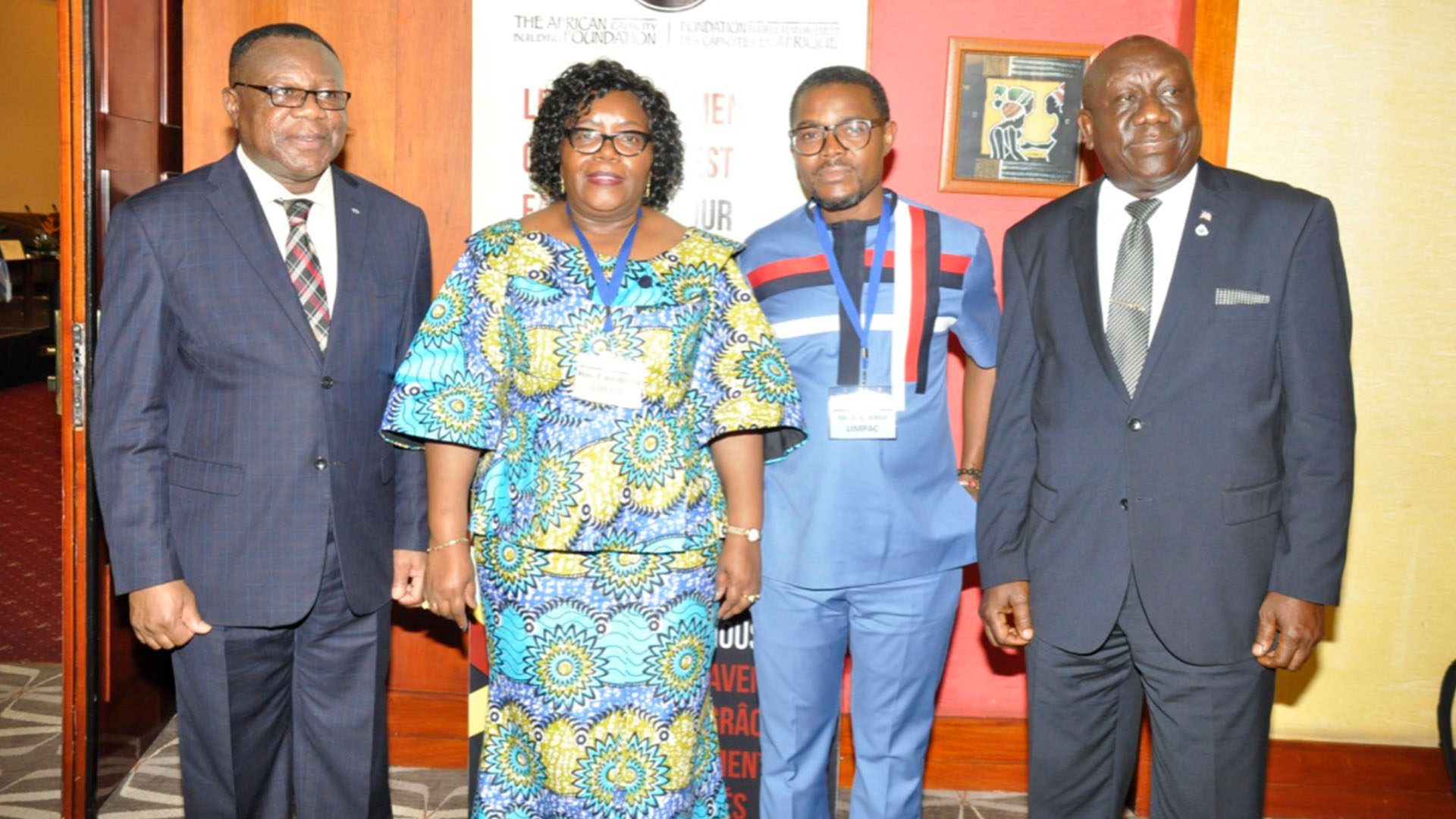
L - R , Prof. Emmanuel Nnadozie, Executive Secretary, ACBF, Hon. Tanneh G. Brunson, Deputy For Budget and Development Planning, MFDP, Mr. Del-Francis Wreh, Executive Director, LIMPAC, Hon. Siaka Fahnbulleh, charge d'affaires

The African Capacity Building Foundation (ACBF) has reaffirmed its support to the rebuilding process of Liberia under the current leadership of President George Manneh Weah. Making the promise during a side meeting with Liberian delegation at the 27th Annual meetings of the Board of Governors of the ACBF held in the Cameroon Capitol of Yaoundé, the ACBF’s Executive Secretary, Professor Emmanuel Nnadozie expressed his gratitude to the people of Liberia for the orderly and peaceful 2017 elections, which ushered in the democratic regime of H.E. George Manneh Weah.


Professor Nnadozie also extended his congratulations to President Weah and promised to support the Liberian leader and government through policy advisory services in addition to the Foundation’s on-going institutional capacity support and strengthening of the Liberia Macroeconomic Policy Analysis Center (LIMPAC).

In response, Hon. Tanneh G. Brunson Deputy Minister of Budget and Developmental Planning on behalf of Minister Tweah thanked Professor Nnadozie and the ACBF for its continual support to Liberia.

Minister Brunson recounted the ACBF support in 2008 toward the establishment of the LIMPAC and its recent and on-going support to LIMPAC for the establishment of Econometric Forecasting and Training Lab within the Ministry of Finance and Development Planning, and support towards the completion of three research studies; IMPACT of UNMIL Drawdown on the Liberian Economy, Assessing TAX ADMINISTRATION challenges on Domestic Revenue mobilization, and Analyzing the advantages and disadvantages of adopting Liberia’s new GDP series.

Minister Brunson also congratulated the ACBF on becoming a specialized unit of the African Union and welcomes advisory services and support of ACBF for Liberia, especially during this critical period of drafting, costing, and finalizing of Liberia’s next medium term development strategy; the Pro-Poor Agenda for Prosperity and Development.

Madam Brunson further lamented that as a specialized unit of the AU, Liberia looks forward to the ACBF’s expertize and support for domesticating the Africa Agenda 2063 and the 2030 sustainable goals of the United Nations to Liberia’s new medium term development agenda.

For his part, LIMPAC Executive Director Mr. Del-Francis Wreh who accompanied Minister Brunson at the 27th Annual meeting also thanked the ACBF for its support to the revitalization of LIMPAC. The LIMPAC Executive Director assured the ACBF boss of LIMPAC’s preparedness to implement projects and programs of the ACBF that promote the socioeconomic improvement of Liberia.

In a related development, the African Capacity Building Foundation has concluded its 27th Annual Board of Governors meetings on July 20, 2018 under the theme “Youth Employment in Africa: Focus on Developing the Critical Skills”.

During the three Panel discussions, panelists shared experiences and challenges across the African continent about the growing youth unemployment and the risks it poses social cohesion and political stability on the continent. During the deliberations, participants highlighted the need for greater resources in addition to political and financial support. In this regards and now more than ever, Africa needs ACBF to not only continue playing its current capacity building coordination role, but to intensify efforts being made to effectively address development bottlenecks and better support skills development interventions. This accordingly requires increased and continual financial support to the ACBF by development partners and member states. Member states including Liberia were also called upon to start paying their respective pledges towards the ACBF’s 2017 – 2023 strategic plans.

Facebook
Twitter